Safety and maintenance of lifting equipment
Posted on avril 8, 2014 by Frank
Lifts, forklifts and other similar devices are very useful in industrial environments. In workshops with very high roofing, a simple stool is rarely sufficient to perform work at height! Forklifts, on another hand, help carrying heavy pallets around. In all cases, this heavy equipment is bought or rented by thousands of Canadian companies each year.
There is a huge issue with these lifts, though: security. Manufacturers and users must comply with very strict regulation in order to protect workers and anyone else that has to pass nearby construction sites.
In the following minutes, we will discuss about a few safety and maintenance rules regarding lifting equipment.

This is a forklift.
Competency of the operator
Even if you deal with a lift rental company, you must hire an operator which has proven his training, knowledge and experience to operate such equipment. When an inspector verifies your operations, he will ensure that your staff has credible training records and that they are familiar with the procedures, the potential hazards as well as the functioning of the specific model of lifting equipment you are using at work.
It is not necessary to complete a full professional training diploma to be able to control a scissor boom lift! Many companies offer a 1 day training that covers all the basics you need to know in order to safely operate a specific model and identify hazards. Of course, this will not be enough to perform full maintenance when needed, but you have to start somewhere!
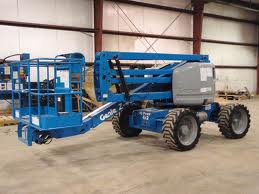
This is a Genie boom lift.
Creating a safe work environment
Think about everyone’s safety by establishing a safe work environment. For example, if you operate a lift while indoors, you have to realize that gas-powered equipment produces a lot of carbon monoxide. This means that if employees can quickly experience the consequences of intoxication if they stay more than a few minutes around the equipment. Most companies, knowing that fact, will buy or rent electric lifting equipment! This will also reduce expenses and make the “refueling” of these lifts a lot simpler.
There are a lot more elements to consider! Protective barriers, signalers, warning lights and audible signals, speed limits… you will have to define clear policies to mitigate the risks of collision between moving equipment and other people. To make sure you do not make costly mistakes, you should consult the current laws in your province or territory regarding safety and lifts.
If you use lifting equipments outside, there is a full list of things you should be watching for. It included electric lines: these devices and machines generally conduce electricity, which could spell death or severe injuries.
Why is maintenance so important?
We talked a bit about maintenance earlier in this article. This is a topic that should not be taken lightly as this complex machinery is prone to breaking after some time, if you do not perform proper verification and repairs. Usually, companies will require a mechanic at least two times a year to perform basic maintenance, may it only be oil change or basic tweaks.
If you neglect this aspect, terrible things could happen. Financially speaking, you can cut the lifetime of your boom lift by half if you decide not to get it verified by competent staff. You could also face mechanical failures at unexpected moments! Imagine a forklift moving at full speed, undergoing a brakes’ failure… that’s a scary thing to think about, isn’t it?
Once again, maintenance is more than often regulated by the authorities. In France, general inspection should take place AT LEAST one time a year.